How to Use AI to Turn Meetings Into Accountability—Not Just More Notes
Meetings should produce results, not just notes. Learn how small businesses can use AI to capture decisions, assign ownership, track deadlines, and turn everyday conversations into measurable accountability.

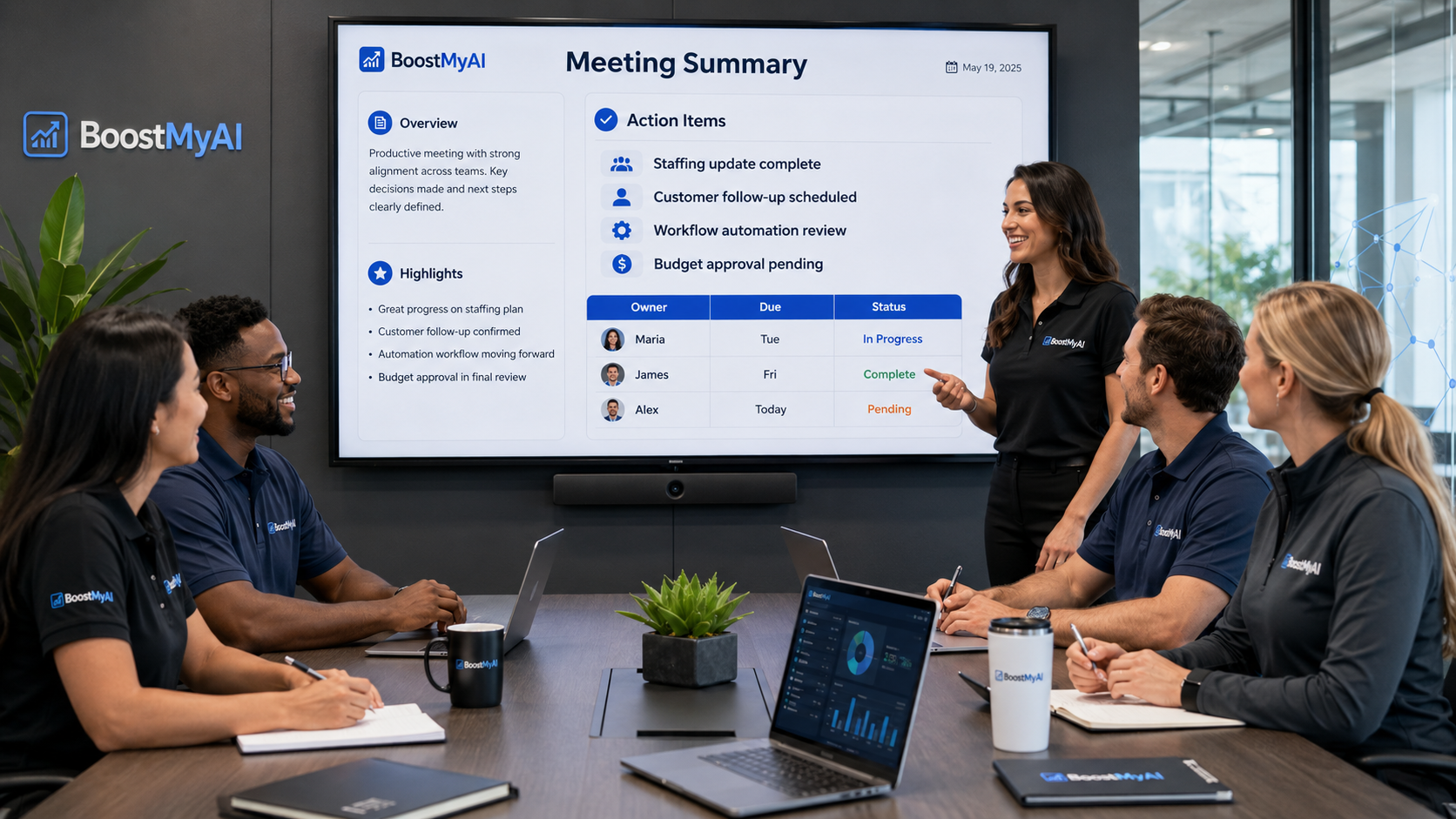
Most businesses do not need more meetings.
They need better follow-through.
A team can spend an hour discussing staffing, customers, deadlines, safety concerns, sales opportunities, and operational problems. Everyone leaves believing the next steps are understood.
Then the week gets busy.
Tasks are forgotten. Deadlines pass. Two people assume the other person was responsible. At the next meeting, the same problems are discussed again.
The meeting was not necessarily the problem. The lack of accountability after the meeting was.
AI can help turn ordinary business meetings into a clear system of decisions, assignments, deadlines, and follow-up.
The Problem With Traditional Meeting Notes
Traditional meeting notes often document what was discussed, but they do not always make it clear what must happen next.
A typical summary may say:
“The team discussed hiring challenges, customer concerns, and the upcoming system rollout.”
That sounds professional, but it does not create accountability.
A useful operational summary should answer:
- What decision was made?
- What action must be completed?
- Who owns it?
- When is it due?
- Who needs to be informed?
- What happens if it is not completed?
Without those answers, meeting notes become a record of conversation instead of a tool for execution.
Step 1: Capture the Meeting
The first step is creating an accurate record of the discussion.
Depending on the type of meeting, a business may use:
- A meeting platform transcript
- A voice recording
- Typed notes
- A shared meeting document
- Notes dictated immediately after the meeting
Always follow company policy and applicable consent requirements when recording or transcribing conversations.
The information does not need to be perfect. It needs to be complete enough for the AI tool to identify decisions, responsibilities, and deadlines.
For informal meetings, a manager can even dictate a summary into a phone immediately afterward:
“We agreed that Maria will contact the supplier by Wednesday, James will update the schedule by Friday, and I will send the customer a progress report tomorrow.”
AI can turn that rough voice note into organized follow-up documentation.
Step 2: Ask AI to Separate Discussion From Decisions
Not everything said during a meeting deserves to be in the final summary.
Some comments are background information. Others are ideas that were discussed but never approved. Some are firm decisions that require action.
AI can help separate those categories.
A useful prompt might be:
“Review this meeting transcript. Separate general discussion, final decisions, unresolved questions, action items, and deadlines. Do not treat suggestions as approved decisions unless the conversation clearly confirms them.”
This distinction matters.
A business does not want an employee acting on an idea that was only briefly discussed. It also does not want an important decision buried inside several pages of notes.
Step 3: Create Clear Action Items
Every action item should include four basic elements:
- The task
- The owner
- The deadline
- The expected result
For example:
Weak action item:
Follow up with the customer.
Strong action item:
Alex will contact the customer by 3:00 p.m. Tuesday, confirm the revised installation date, and send the team a written update.
The second version leaves little room for confusion.
AI can review a transcript and create a structured action list, but a manager should still verify it. The AI may identify the assignment correctly while missing a deadline that was implied rather than clearly stated.
That is why managers still need to manage.
AI can organize the information. Leadership must confirm the expectations.
Step 4: Give Every Task One Owner
One of the oldest accountability problems in business is assigning a task to a group.
“The operations team will handle it.”
“Management will follow up.”
“Someone needs to contact the vendor.”
When everyone owns a task, no one owns it.
Each action item should have one primary person responsible for completion. Other employees can assist, but one name should appear beside the task.
AI can flag vague ownership by identifying action items assigned to departments, groups, or unnamed individuals.
A useful prompt might be:
“Identify every action item that does not have one clearly named owner. List those items separately so responsibility can be assigned.”
That simple review can prevent a surprising number of missed commitments.
Step 5: Draft the Follow-Up Email Immediately
Meeting summaries are most useful when they are sent while the discussion is still fresh.
AI can turn the transcript or notes into a follow-up email that includes:
- Key decisions
- Action items
- Assigned owners
- Due dates
- Unresolved issues
- The next meeting date
- Items that require leadership approval
The manager should review the email before sending it, especially when the meeting involves customers, employees, legal concerns, discipline, safety, or financial commitments.
The goal is not to blindly send AI-generated notes.
The goal is to reduce the time between the meeting and the written confirmation of expectations.
A summary sent five minutes after a meeting is far more valuable than one reconstructed from memory three days later.
Step 6: Maintain a Running Accountability Tracker
A meeting summary should not disappear into an inbox.
Action items can be transferred into a simple tracker containing:
| Action Item | Owner | Due Date | Status | Last Update |
|---|---|---|---|---|
| Confirm supplier delivery | Maria | May 12 | In Progress | Supplier contacted |
| Update weekend schedule | James | May 10 | Completed | Schedule published |
| Send customer report | Alex | May 9 | Overdue | No update received |
This tracker can be maintained in a spreadsheet, project management platform, shared document, or other system the business already uses.
Do not buy a complicated platform unless the business actually needs one.
A simple system that employees consistently update is better than an expensive system nobody uses.
AI can help clean up the tracker, standardize updates, identify overdue items, and prepare a status summary for management.
Step 7: Follow Up Before the Deadline
Accountability should not begin after a task is overdue.
AI can help managers review upcoming deadlines and prepare reminder messages.
For example:
“Review this action-item tracker. Identify tasks due within the next three business days, overdue tasks, and tasks without a recent update. Draft a brief follow-up message for each owner.”
This gives managers an early warning system.
The purpose is not to create constant automated nagging. The purpose is to make sure important commitments do not quietly disappear.
A good manager still needs to understand the employee, the task, and the situation. Some people respond well to a reminder. Others may need a direct conversation.
AI supports the follow-up. It does not replace leadership.
Step 8: Start the Next Meeting With Unfinished Business
Many businesses begin each meeting with new topics before reviewing commitments from the last meeting.
That encourages teams to move on without finishing what they already agreed to do.
Instead, begin with:
- Completed action items
- Overdue action items
- Blocked tasks
- Decisions still awaiting approval
- Commitments that need new deadlines
AI can prepare this section before the meeting by reviewing the previous summary and the current accountability tracker.
A useful prompt might be:
“Create a five-minute opening accountability review for tomorrow’s meeting. Show completed items, overdue items, blocked items, and decisions still needed.”
This changes the culture of the meeting.
Employees begin to understand that commitments will be reviewed, not forgotten.
Step 9: Identify Recurring Operational Problems
Meeting information becomes even more valuable when reviewed over time.
AI can analyze several weeks or months of summaries and identify patterns such as:
- The same deadlines being missed
- Repeated staffing problems
- Customer concerns that remain unresolved
- Tasks that frequently lack a clear owner
- Projects delayed by the same department
- Issues discussed repeatedly without a final decision
- Managers carrying too many action items
These patterns are difficult to see when meeting notes are stored in separate emails or documents.
AI can help leadership move beyond individual problems and identify weaknesses in the operation itself.
For example, if hiring is discussed in every weekly meeting but no progress is made, the problem may not be employee effort. The recruiting process, pay rate, approval system, or hiring standards may need to be reviewed.
A Simple AI Meeting Workflow
A small business can begin with a straightforward process:
- Capture the meeting transcript or notes.
- Ask AI to identify decisions, action items, owners, and deadlines.
- Review the summary for accuracy.
- Send the follow-up email.
- Add action items to a shared tracker.
- Review upcoming and overdue tasks during the week.
- Begin the next meeting with unfinished business.
This does not require a major software implementation.
It requires discipline.
AI makes the process faster, but leadership must establish the expectation that assignments are documented, tracked, and completed.
What AI Should Not Decide
AI should not independently decide:
- Who should be disciplined
- Whether an employee’s explanation is acceptable
- Whether a customer commitment should be changed
- Whether a safety or legal issue can be ignored
- Whether spending should be approved
- Whether a deadline should be extended
- Whether confidential information should be distributed
Those decisions belong to responsible leaders.
AI can summarize the facts, identify missing information, and prepare the documentation. The final judgment remains human.
The Business Impact
Using AI to improve meeting accountability can help a business:
- Reduce repeated discussions
- Improve follow-through
- Clarify responsibilities
- Catch missed deadlines earlier
- Create a written record of decisions
- Reduce misunderstandings
- Make meetings shorter and more focused
- Help managers prepare faster
- Identify recurring operational problems
The real value is not the meeting summary itself.
The value is what gets completed because the summary exists.
Final Thought
A productive meeting should create movement.
Something should be decided. Someone should be responsible. A deadline should be established. Progress should be reviewed.
AI can help capture and organize that process, but it cannot create accountability by itself.
That still requires clear expectations, consistent follow-up, and leaders who do what they say they will do.
Used correctly, AI does not simply take better meeting notes.
It helps turn business conversations into results.
How BoostMyAI Can Help
BoostMyAI helps small businesses develop practical AI workflows that improve communication, accountability, training, and daily operations.
We help businesses select the right tools, create repeatable processes, build useful prompts, and train employees to use AI responsibly.
The goal is not more technology.
The goal is better execution.
Contact us today to get started!