The AI Business Continuity Playbook: Preparing Your Small Business for the Unexpected
When disruption hits, the biggest problem is often not the emergency—it’s confusion. Learn how AI can help your business prepare, communicate and continue operating when the unexpected happens.

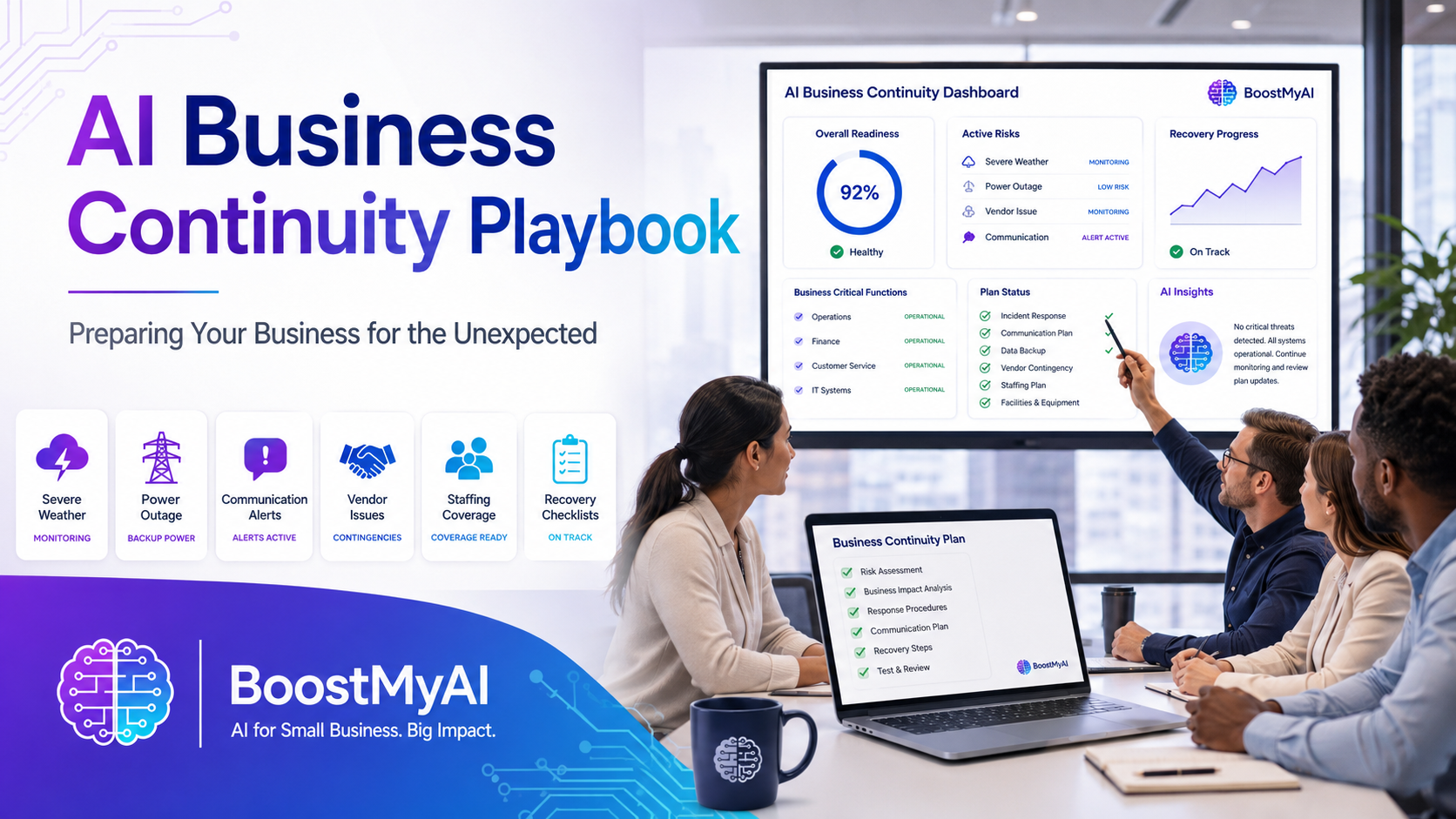
Most small businesses have a plan for growth. Far fewer have a real plan for what happens when operations suddenly fall apart.
A hurricane shuts down the office. The internet goes out. A critical employee becomes unavailable. A vendor fails to deliver. A cyber incident locks employees out of essential systems. The owner is unreachable, and everyone is waiting for instructions.
When disruption hits, the biggest problem is often not the emergency itself. It is confusion.
Employees do not know who is in charge. Contact information is scattered across phones and inboxes. Customers receive inconsistent updates. Important tasks are forgotten, and decisions are made on the fly.
Artificial intelligence can help small businesses build a practical business continuity playbook before it is needed—and help manage the response when something goes wrong.
What Is a Business Continuity Playbook?
A business continuity playbook is a clear set of instructions explaining how the company will continue operating during an emergency or major disruption.
It should answer basic operational questions:
- Who makes decisions?
- How will employees communicate?
- Which business functions must continue?
- How will customers be notified?
- What happens if the building cannot be accessed?
- Which vendors and systems are critical?
- How will the company return to normal operations?
This does not need to be a 100-page corporate disaster manual. For most small businesses, a concise and usable plan is far more valuable than a complicated document nobody reads.
How AI Can Help Build the Plan
AI can organize scattered business information and turn it into structured procedures.
A business owner can provide existing policies, employee responsibilities, vendor contacts, customer communication templates, emergency procedures and operational notes. AI can then help organize that information into a consistent continuity plan.
For example, AI can create separate response procedures for:
- Severe weather
- Power or internet outages
- Cybersecurity incidents
- Building closures
- Vendor failures
- Staff shortages
- Leadership absences
- Equipment breakdowns
Instead of starting with a blank page, management can use AI to create a first draft and then review it with employees who understand the operation.
AI should not make final emergency decisions for the company. It should help management organize information, identify gaps and create clearer instructions.
Establish a Clear Chain of Command
Every continuity plan should identify who is authorized to make decisions when normal leadership is unavailable.
The plan should list a primary decision-maker, a backup and an additional alternate. Employees should not have to search through text messages to determine who is running the operation.
AI can help create a responsibility matrix showing who handles:
- Employee communications
- Customer notifications
- Scheduling
- Vendor coordination
- Technology issues
- Facility access
- Payroll questions
- Public or social media communication
The goal is simple: everyone should know who owns each responsibility.
Create Communication Templates Before the Emergency
During a disruption, leaders often waste valuable time trying to write the perfect message.
AI can help create communication templates in advance for employees, customers, vendors and other stakeholders.
Templates might include:
- Temporary closure notices
- Delayed opening announcements
- Remote-work instructions
- Service interruption updates
- Employee call-in procedures
- Customer reassurance messages
- Reopening announcements
These messages can be reviewed and approved ahead of time. During an emergency, management only needs to update the specific details.
That allows the company to communicate quickly while maintaining a professional and consistent message.
Identify the Functions That Must Continue
Not every business activity is equally important during a disruption.
A continuity plan should identify the functions that must continue immediately, those that can be delayed and those that can temporarily stop.
Critical functions might include customer support, scheduling, payroll, order processing, security, billing or access to important records.
AI can help management categorize business activities and create a prioritized recovery checklist.
For each critical function, the plan should identify:
- The responsible employee
- The backup employee
- The systems required
- The information required
- The acceptable downtime
- The temporary manual process
This is especially important when one employee holds most of the knowledge about a particular process.
Prepare for Key Employee Absences
Small businesses are often heavily dependent on a few experienced people.
When one of those employees is unavailable, the company may discover that nobody else knows the passwords, procedures, contacts or next steps.
AI can help turn employee knowledge into written procedures, checklists and training materials. Employees can describe how they perform a task, and AI can organize the information into a repeatable process.
This creates a practical backup plan and reduces the risk of critical knowledge walking out the door.
Centralize Important Information
Emergency contact lists are useless if they are outdated or cannot be found.
The continuity playbook should include or reference a secure, centralized location containing:
- Employee contact information
- Vendor contacts
- Insurance information
- Utility providers
- Technology support contacts
- Building management contacts
- Customer escalation contacts
- Emergency services information
- Equipment information
- System access instructions
Sensitive information should be stored securely with appropriate access controls. AI can help organize the information, but confidential passwords and personal information should not be entered into unsecured public systems.
Use AI During the Response
Once an emergency begins, AI can help management process information and maintain organization.
It can summarize updates from multiple employees, create situation reports, identify unresolved tasks and prepare communications.
For example, management could provide AI with updates such as:
- Three employees are unavailable
- The office has no power
- Customer calls are being forwarded
- Payroll must be submitted by noon
- A vendor delivery has been delayed
AI can organize the information into an action list showing what has been completed, what remains open, who is responsible and which issue requires immediate attention.
This can reduce confusion during fast-moving situations.
Build a Return-to-Normal Checklist
Business continuity does not end when the immediate emergency is over.
The company also needs a plan for returning to normal operations.
AI can help create a recovery checklist that includes:
- Confirming employee availability
- Inspecting facilities and equipment
- Restoring systems
- Notifying customers
- Rescheduling missed work
- Reviewing payroll impacts
- Following up with vendors
- Documenting losses
- Reporting insurance claims
- Conducting an after-action review
After the disruption, AI can also help summarize what worked, what failed and what should be changed before the next emergency.
Keep the Playbook Updated
A continuity plan created once and ignored will eventually become useless.
Employees change. Vendors change. Systems change. Phone numbers change. Business priorities change.
The plan should be reviewed at least annually and whenever the company experiences a major operational change.
AI can simplify the review process by comparing the existing plan against updated employee lists, procedures and vendor information. It can highlight sections that may be outdated or incomplete.
Preparation Beats Panic
Small businesses may not have the resources of a major corporation, but they can still prepare professionally.
The purpose of a business continuity plan is not to predict every possible emergency. It is to create enough structure that employees can respond calmly, communicate clearly and keep the most important parts of the business operating.
AI makes that process faster and more accessible. It helps businesses organize what they already know, document what has never been written down and create a playbook employees can actually follow.
The best time to build that playbook is not when the power is out, the phones are ringing and nobody knows who is in charge.
The best time is now.
How BoostMyAI Can Help
BoostMyAI helps small businesses use artificial intelligence to strengthen operations, organize critical knowledge and build practical systems that employees can use.
From continuity plans and communication templates to employee procedures and operational checklists, we help turn scattered information into clear, actionable tools.
Contact us today to learn how AI can help your business prepare for the unexpected.