Maybe You Don’t Need Another Software Subscription
Custom software used to be something only large companies could afford. AI-assisted development is changing that. Instead of forcing your business to fit another off-the-shelf subscription, it may now be practical to build a focused tool around your actual workflow, processes, and needs.
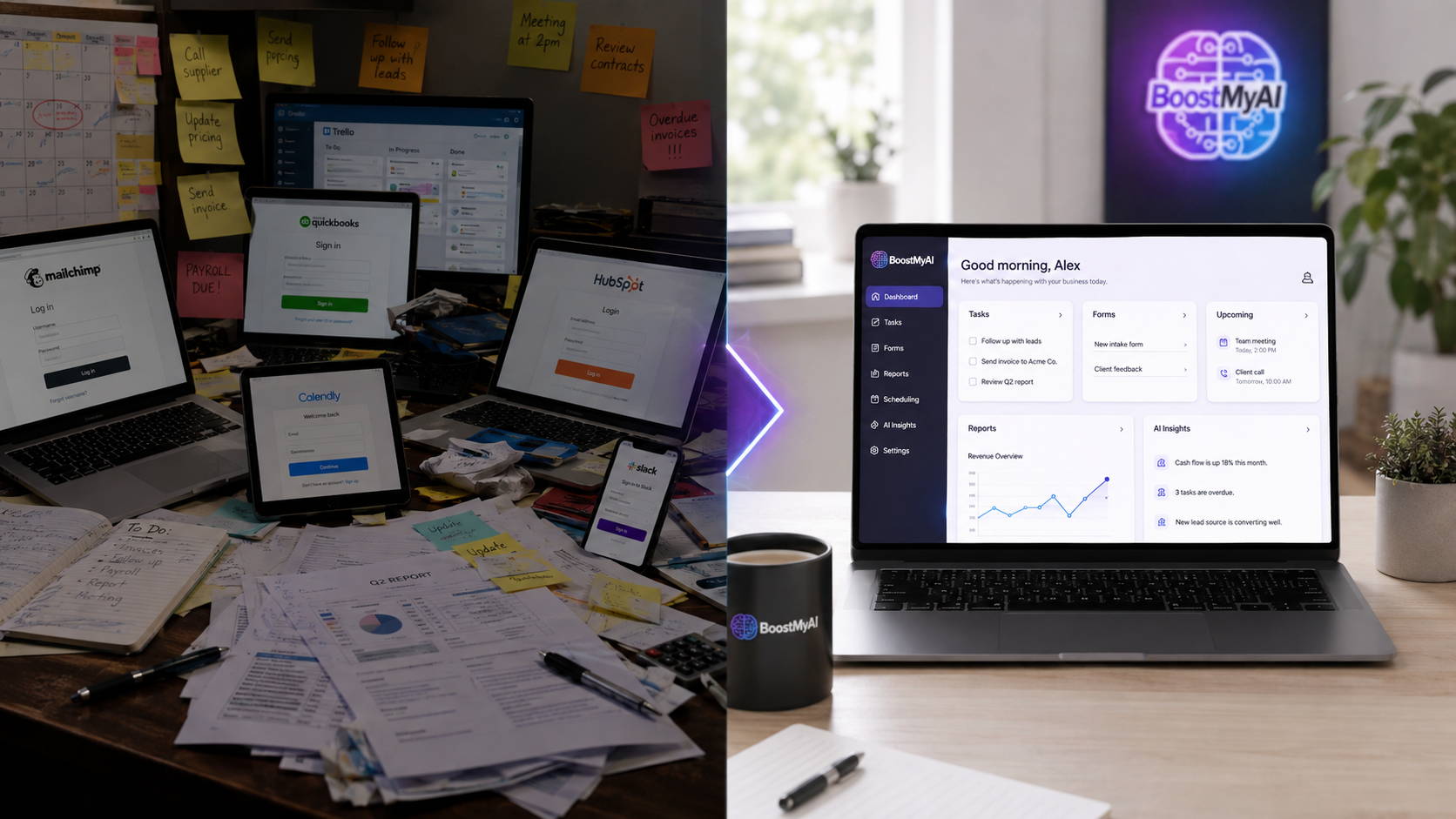
Small businesses have spent years piling up software subscriptions.
One system for scheduling. Another for customer management. Another for reporting. Another for forms. Another for communication. Another for tracking tasks.
Before long, you have ten different systems, five logins nobody remembers, and employees using a spreadsheet anyway because the software doesn’t quite do what they need.
That raises a simple question:
What if you stopped looking for software that almost fits your business and built something that actually does?
AI Is Changing the Cost of Custom Software
Custom software used to be out of reach for most small businesses. Building even a relatively simple internal application could require developers, designers, project managers, months of work, and a budget that made the idea unrealistic.
AI-assisted development is changing that.
Today, it is increasingly possible to build focused internal tools much faster and at a fraction of the traditional cost. That does not mean every business should start replacing all of its software. But it does mean custom development is no longer automatically reserved for large companies with large IT budgets.
The Problem With “One Size Fits All”
Most commercial software is designed to serve thousands of customers. That means it has to accommodate thousands of different workflows.
The result is often a system packed with features you never use while still missing one or two things your business actually needs.
You end up changing your process to fit the software.
Custom tools flip that around.
The software can be built around your process, your terminology, your rules, and your employees.
Maybe you need an application that combines several reports into one management view. Maybe you need a simple tool that guides employees through a company-specific process. Maybe you want customer information, operational data, and AI analysis available in one place.
The point is not to build the biggest system possible.
The point is to build the right system.
Start With the Annoyance
Some of the best custom software ideas start with a sentence like:
- “Why do we have to enter this twice?”
- “Why are we still doing this manually?”
- “Why do I need three reports to figure this out?”
- “Why can’t the system just tell me what I need to know?”
- “Why doesn’t our software do this?”
Those frustrations are worth paying attention to.
If employees are constantly working around a system, maintaining separate spreadsheets, copying information between applications, or performing repetitive tasks that could be automated, there may be an opportunity to build something better.
AI Can Be Part of the Tool, Not the Whole Tool
Not every custom application needs to look like a chatbot.
AI can operate behind the scenes.
It might review information, summarize reports, find exceptions, answer questions about company procedures, classify incoming requests, generate documents, or help employees make better decisions.
The user may simply see a clean application designed around the job they are trying to accomplish.
Instead of asking, “How can we use ChatGPT?”
Ask:
“What problem in our business would be easier if we had the right tool?”
Then determine whether AI belongs inside that solution.
Don’t Replace Good Software Just Because You Can
There is no reason to rebuild something that already works well.
If your payroll system does exactly what you need, leave it alone. If your CRM works, keep it. If an existing product solves the problem at a reasonable price, buying it may still be the smartest decision.
Custom development makes the most sense when there is a specific gap: something unique to your operation that commercial software does poorly, requires too much manual work, or simply does not provide.
That is the opportunity.
Build Small, Then Improve It
A custom tool does not need to begin as a massive project.
Start with one workflow. One problem. One group of users.
Build the smallest useful version, put it in front of the people who will actually use it, and see what happens.
Then improve it.
That approach is faster, less expensive, and usually produces better software because the application evolves around real-world use instead of assumptions made in a conference room.
The Question Has Changed
For years, small businesses asked:
“What software can we buy that does what we need?”
That is still a good question.
But AI has added another one:
“Could we build exactly what we need instead?”
Sometimes the answer will still be no.
Increasingly, though, the answer is yes.
And that could change the way small businesses think about software entirely.
Ready to Build Something Better?
If your business is working around software that does not quite fit, relying on spreadsheets to fill the gaps, or spending too much time on repetitive processes, there may be a better way.
BoostMyAI helps small businesses identify where AI and custom tools can save time, simplify operations, and solve real business problems.
Contact us at BoostMyAI.com and let’s talk about what you could build.