Stop Managing the Normal: Use AI to Find the Exceptions
Your managers need to know what requires attention. AI can review schedules, reports, invoices, payroll, inventory, and other business data, then flag the exceptions, helping managers spend less time searching for problems and more time solving them.

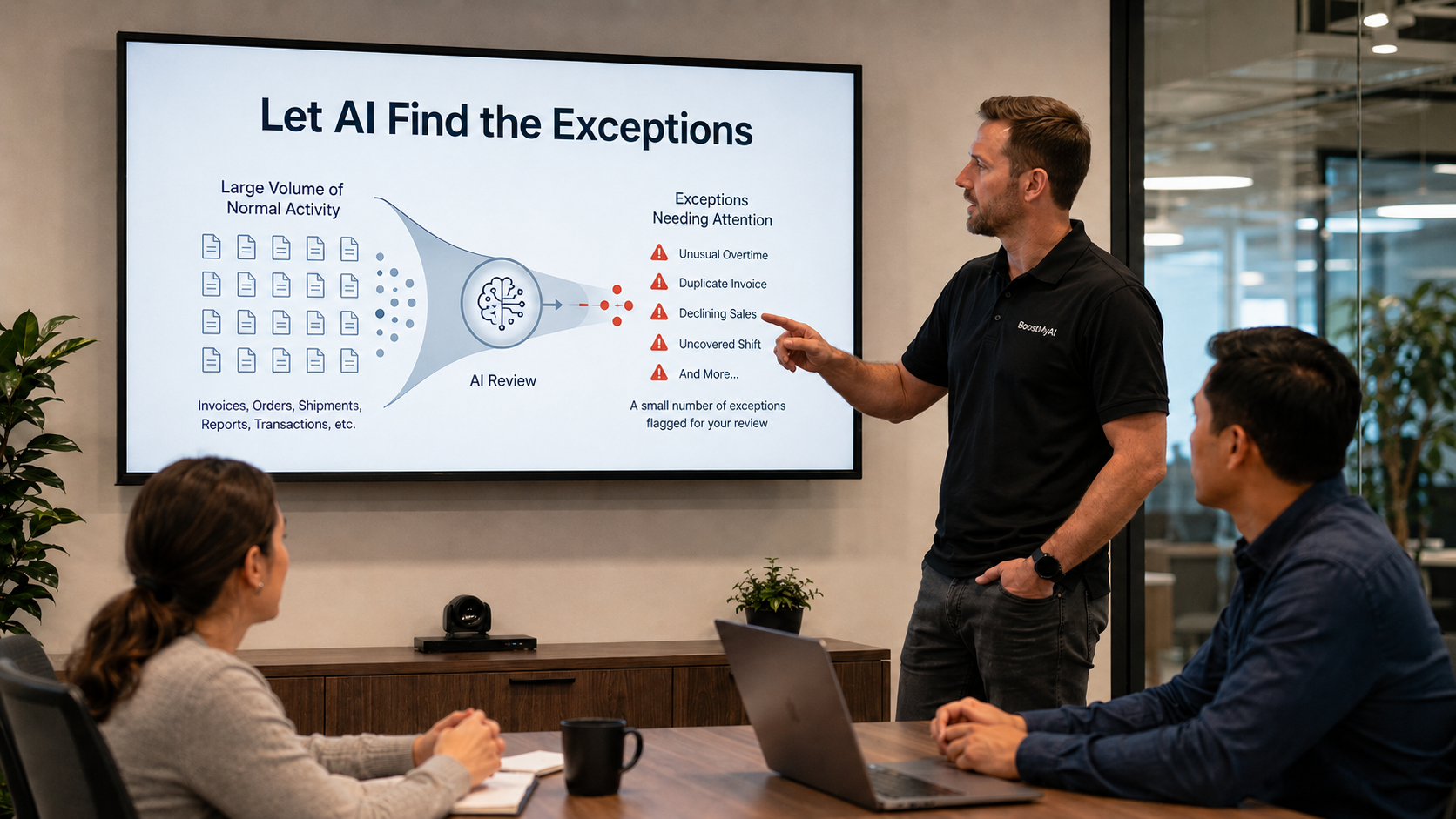
Most managers spend too much time reviewing things that are perfectly fine. They check schedules that are fully staffed, reports with no issues, invoices that match expectations, timecards with nothing unusual, and spreadsheets where 98% of the information requires no action.
Then, buried somewhere in all that normal activity, is the one thing they actually needed to see.
That is a lousy use of management time. And it is exactly the kind of problem AI is good at solving.
Management by Exception
There is an old management concept called management by exception. The idea is simple: establish what normal looks like, then concentrate management attention on anything that falls outside of it.
If everything is operating within expectations, leave it alone. If something looks unusual, investigate it.
That concept isn't new. What is new is our ability to use AI to perform much of that first-level review automatically.
Instead of asking a manager to examine 500 transactions, records, reports, or activities, AI can examine all 500 and say:
"These six deserve your attention."
That is a much better use of technology.
Your Managers Don't Need More Data
Businesses already have plenty of data—usually too much of it. Schedules, payroll reports, sales reports, invoices, inspection forms, inventory reports, customer complaints, work orders, expense reports, employee activity, emails, and service reports.
The problem isn't getting information. The problem is figuring out which information matters right now.
Traditional software usually gives you another dashboard, another chart, another spreadsheet, or another report. Congratulations. Now your manager has one more screen to stare at.
AI can take a different approach. Instead of displaying everything, it can help identify what is different, unexpected, inconsistent, missing, or potentially wrong.
What Could AI Look For?
Imagine giving AI access to information your business already produces and teaching it what "normal" looks like. It could flag things such as:
- Unusual or excessive overtime
- Duplicate or questionable invoice charges
- Customers whose purchases suddenly decline
- Missed inspections or required tasks
- Uncovered shifts or scheduling conflicts
- Expenses that jump unexpectedly
- Inventory usage outside normal patterns
- Conflicting reports or records
- Repeated maintenance issues
- Deadlines approaching without required action
None of those examples require AI to make the final decision. They require AI to say:
"Hey, somebody should probably look at this."
That distinction matters.
AI Doesn't Have to Run the Business
There is a tendency to think every AI project needs to automate an entire job. It doesn't.
Sometimes the best AI implementation simply makes a good employee faster.
A manager still decides whether overtime was justified. Accounting still determines whether an invoice is correct. Operations still decides how to handle an uncovered shift. The business owner still calls the customer whose sales suddenly dropped.
AI simply helps them find the problem sooner.
Think of it as another set of eyes capable of reviewing enormous amounts of information without getting bored somewhere around row 347 of the spreadsheet.
Humans aren't particularly good at staring at repetitive information looking for tiny abnormalities. Computers are.
We should probably let each side do what it does best.
Start With Rules You Already Know
Most businesses already have informal rules experienced employees use every day:
- "If overtime gets above this number, I want to know."
- "If this customer hasn't ordered in 30 days, call them."
- "If inventory drops below this amount, reorder."
- "If an invoice is significantly higher than last month, check it."
- "If a required inspection is missed, notify the supervisor."
- "If two systems tell us different things, investigate."
Those rules already exist. They're just sitting inside somebody's head.
AI gives businesses an opportunity to turn that experience into a repeatable system.
The Real Value Is Attention
One of the scarcest resources in any business is management attention.
You can hire more people. You can buy more software. You can generate more reports. But there are still only so many hours in the day.
Every hour a manager spends looking at something that doesn't require action is an hour they aren't spending on employees, customers, operations, sales, or growth.
That's why exception-based AI can create significant value without looking flashy. It isn't about building a robot CEO. It's about giving the actual CEO, manager, supervisor, or business owner a shorter list of things they need to worry about.
Turn 1,000 Records Into 12
Suppose a business generates 1,000 operational records every week. Today, someone may have to review a large portion of those records just to determine whether problems exist.
Now imagine AI reviews all 1,000, compares them against company standards, historical patterns, and predetermined rules, then produces this:
988 records appear normal.
12 require review.
The manager starts with 12 instead of 1,000.
That's not replacing the manager. That's giving the manager their time back.
AI Can Spot Patterns Humans Miss
Some problems aren't obvious when looking at individual records.
One late inspection may mean nothing. Six late inspections at the same location over three weeks might.
One invoice increase may be insignificant. Gradual increases every month for a year might deserve attention.
One employee leaving early may be perfectly legitimate. A repeated pattern may tell a different story.
Humans are good at understanding context. AI can be very good at spotting patterns across large amounts of information.
Put the two together and you have something useful.
Don't Automate Bad Processes
Before giving AI responsibility for identifying exceptions, you need to decide what actually constitutes an exception.
If your processes are inconsistent, your data is terrible, or nobody agrees on the rules, AI won't magically fix that. It may simply identify the inconsistencies faster.
Sometimes implementing AI exposes something businesses would rather not admit:
The process itself needs work.
That's not a failure. That's useful information.
A good implementation starts by answering a few basic questions: What should happen? What normally happens? What requires management attention? Who should be notified? What should happen next?
Answer those first. Then automate the boring part.
Start Small
You don't need to connect AI to everything your business does tomorrow. Pick one repetitive review process—overtime, invoices, inventory, customer activity, inspections, scheduling, or something similar.
Ask yourself:
What does someone currently spend time reviewing just to find the few things that are wrong?
That's probably a good place to start.
Build a simple system. Teach it what deserves attention. Test it. Adjust the rules. Then expand.
Stop Reviewing What Doesn't Need You
AI gets marketed with a lot of dramatic promises: replace entire departments, transform every business process, reinvent work.
Sometimes the practical opportunity is much simpler.
If 97 things went right today and three things went wrong, your manager should not have to review all 100 to figure out which three matter.
Let AI watch the normal. Let your people manage the exceptions.
That may be one of the most practical uses of AI your business can implement. Get started today by contacting us!