The AI Compliance Calendar: Never Miss Another License, Permit or Certification Renewal
Missed licenses, permits and certification renewals can cost a small business time, money and credibility. An AI-powered compliance calendar can organize documents, track expiration dates, assign responsibility and send reminders before deadlines become problems.

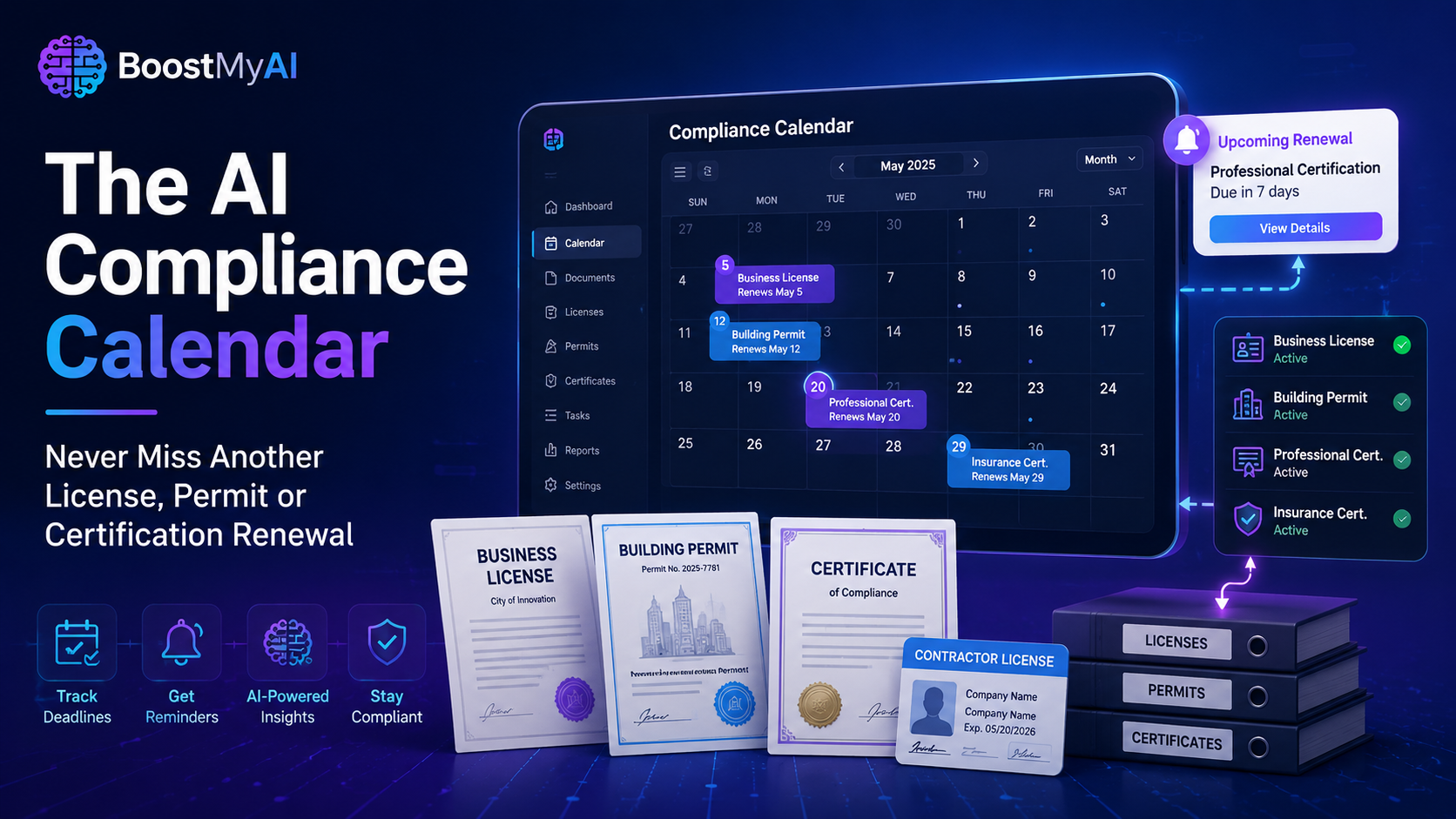
Running a small business means keeping track of more deadlines than most owners ever expected.
Business licenses expire. Insurance certificates need updating. Employee certifications must be renewed. Permits come due. Contracts have notice periods. Vehicle registrations, inspections and professional credentials all carry expiration dates.
Miss one, and the consequences can range from an inconvenient late fee to a lost customer, suspended operation or serious compliance problem.
The trouble is not usually a lack of effort. It is the way many businesses still manage these obligations.
A spreadsheet sits on someone’s computer. Renewal notices land in different inboxes. Important dates are buried in PDFs. One employee knows the process, but nobody else does. The entire system depends on somebody remembering to check.
That may have worked when the business was smaller. It becomes dangerous as the company grows.
An AI-supported compliance calendar can bring those scattered deadlines into one organized system.
What Is an AI Compliance Calendar?
An AI compliance calendar is a centralized system that tracks licenses, permits, certifications, insurance documents, contracts and other time-sensitive business requirements.
Unlike a basic calendar reminder, it can help organize the documents, identify important dates, assign responsibility and create a repeatable renewal process.
Depending on the tools a business uses, the system may be able to:
- Extract expiration dates from uploaded documents
- Categorize licenses, permits and certifications
- Create reminders before each deadline
- Assign renewal tasks to specific employees
- Draft follow-up emails
- Track whether required documents were received
- Flag missing or expired credentials
- Maintain a record of completed renewals
- Produce reports for management or audits
The goal is not to let AI make compliance decisions. The goal is to stop relying on memory, scattered emails and outdated spreadsheets.
The Real Cost of a Missed Deadline
A missed renewal can create more damage than the renewal fee itself.
Consider a few common examples:
- A customer requests an updated certificate of insurance, but nobody realizes the current document has expired.
- An employee continues working after a required certification lapses.
- A professional license renewal is missed because the reminder went to a former employee.
- A vehicle registration or inspection expires and takes a company vehicle out of service.
- A contract automatically renews because the cancellation deadline was overlooked.
- A permit expires and delays work at a customer location.
These mistakes can damage credibility. Customers expect vendors to maintain their required documentation without being chased.
A company that cannot produce current records may appear disorganized, even when its actual work is excellent.
Compliance is not glamorous, but it is part of delivering dependable service.
Why Traditional Tracking Systems Break Down
Most small businesses already have some method of tracking expiration dates. The problem is that the system often depends too heavily on one person.
Common warning signs include:
- Multiple spreadsheets with conflicting information
- Renewal dates stored only in individual calendars
- Documents saved under inconsistent file names
- Reminders sent to employees who no longer work for the company
- No backup person assigned
- No way to confirm that the renewal was completed
- No central location for current documents
- Management learning about expired credentials after a customer asks
Spreadsheets are still useful. Email is still useful. Calendars are still useful.
The mistake is expecting any one of them to manage the entire process without structure.
AI can help connect the pieces.
How the System Could Work
A practical AI compliance process does not need to be complicated.
Step 1: Gather the Documents
Start by collecting the documents that contain expiration dates or renewal requirements.
These may include:
- Business licenses
- Professional licenses
- Insurance certificates
- Employee certifications
- Safety training records
- Vendor credentials
- Permits
- Vehicle registrations
- Equipment inspections
- Leases
- Service agreements
- Customer contracts
The documents should be stored in a secure, organized location with appropriate access controls.
Step 2: Extract the Important Information
AI tools can help read documents and identify key information such as:
- Document type
- License or certificate number
- Issuing organization
- Effective date
- Expiration date
- Renewal requirements
- Responsible employee
- Customer or location connected to the document
Human review is still necessary. AI can misread a date, confuse an issue date with an expiration date or miss language buried in a contract.
The right approach is simple: let AI do the first pass, then have a person verify the information.
Step 3: Create Multiple Reminder Points
A single reminder the day before expiration is not a compliance system.
Renewals often require applications, payment, training, inspections, approvals or supporting documentation.
A better process may include reminders:
- 90 days before expiration
- 60 days before expiration
- 30 days before expiration
- 14 days before expiration
- On the expiration date
- After expiration if the task remains incomplete
The timing should match the actual renewal process. A simple vehicle registration may need less preparation than a professional license or customer-required certification.
Step 4: Assign Ownership
Every compliance item should have one primary owner and, when appropriate, a backup.
The system should clearly answer:
- Who starts the renewal?
- Who approves the payment?
- Who completes required training?
- Who uploads the updated document?
- Who verifies that the process is finished?
- Who is notified if the deadline is missed?
“Everyone is responsible” usually means nobody is responsible.
Step 5: Track Completion
A reminder is only the beginning.
The system should track the status of each item, such as:
- Current
- Renewal upcoming
- Renewal started
- Waiting for employee
- Waiting for vendor
- Waiting for payment
- Waiting for approval
- Completed
- Expired
- Not applicable
This gives management visibility before a problem occurs.
Where AI Adds the Most Value
The biggest benefit is not the calendar itself. Businesses have had digital calendars for years.
The value comes from reducing the manual work surrounding the calendar.
AI can help summarize renewal instructions, draft reminder messages, organize documents and identify missing information.
For example, instead of a manager manually writing the same email every month, AI could prepare a message such as:
Your certification expires in 30 days. Please complete the required renewal process and submit the updated certificate by the listed deadline.
AI could also prepare a weekly management summary showing:
- Items expiring within 90 days
- Renewals that have not been started
- Employees with missing documentation
- Customers waiting for updated certificates
- Recently completed renewals
- Items requiring management attention
That is far more useful than opening a spreadsheet and scanning hundreds of rows.
Start Small
A business does not need to automate every compliance process on the first day.
Start with one category that creates the most risk.
Good starting points include:
- Employee licenses and certifications
- Certificates of insurance
- Vehicle registrations and inspections
- Customer-required training
- Business permits
- Contract renewal dates
Build the process, test the reminders and confirm that employees understand their responsibilities.
Once the system works, expand it.
Trying to automate everything at once usually creates confusion. A smaller working system is better than an impressive system nobody maintains.
Security and Privacy Still Matter
Compliance records may contain sensitive business or employee information.
Before uploading documents into an AI platform, the business should understand:
- Where the information is stored
- Who can access it
- Whether the data is used to train public models
- How long information is retained
- Whether the tool meets customer or industry requirements
- What information should be removed or redacted
Not every document belongs in a general-purpose AI tool.
Businesses should use approved platforms, limit access and maintain clear policies for handling confidential information.
AI Does Not Replace Accountability
An AI compliance calendar is a tool, not a compliance officer.
It cannot guarantee that a license was renewed correctly. It cannot determine whether every law or customer requirement applies. It should not be trusted to make final legal, regulatory or contractual decisions without qualified human review.
What it can do is make the process harder to ignore.
It can surface upcoming deadlines, reduce repetitive administrative work and give management a clearer view of risk.
That matters because most compliance failures are not caused by complicated legal questions. They are caused by ordinary breakdowns:
- Nobody entered the date.
- The reminder went to the wrong person.
- The employee left the company.
- The document was renewed but never uploaded.
- Everyone assumed somebody else handled it.
AI can help close those gaps.
From Reactive to Proactive
Many businesses manage compliance reactively.
A customer asks for a document, and employees scramble to find it. A license expires, and management rushes to fix it. An audit is announced, and everyone starts searching through emails and folders.
A well-designed compliance calendar changes that pattern.
Management can see what is coming. Employees know what they own. Records stay organized. Customers receive updated documents before they have to ask.
That is not just compliance. It is good operations.
The businesses that benefit most from AI will not always be the ones using the flashiest technology. They will be the ones applying it to ordinary problems that cost time, create risk and frustrate customers.
Tracking expiration dates may not sound revolutionary.
Neither does missing one—until it stops your business from operating.
How BoostMyAI Can Help
BoostMyAI helps small businesses turn practical AI ideas into working business processes. That may include organizing compliance records, developing renewal workflows, setting up reminder systems, creating AI-assisted reporting and training employees on how to use the process responsibly.
The goal is not to add another complicated piece of software.
The goal is to build a dependable system that helps your business stay organized, prepared and ahead of the deadline.
Contact us today to get started!